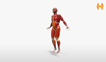
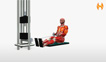
V-Grip Seated Row
The "V" grip (close-grip) seated row is an excellent exercise for building the lats and mid back. The teres major, rhomboids, trapezius, and rear-delts also assist in this exercise. The close-grip places additional emphasis on the biceps and forearms. Squeeze your scapula together for peak-contraction.
Walking Dumbbell Swing
The Walking Dumbbell Swing is a more complex version of the Dumbbell Swing. The Walking Dumbbell Swing is great for building power and endurance in your hips and posterior chain. It also helps improve coordination and build athleticism.
Ball PowerBlock Shoulder Press
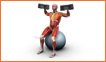
The PowerBlock shoulder press performed while seated on the ball is a great exercise for building shoulder strength while at the same time working the core muscles. As you press the weight overhead you activate more of the core in order to stabilize your spine. This is a good way to add variety to your training plan. You can add this exercise to your workout plan if you are bored with your current routine.
Wide-Stance Barbell Parallel Squat
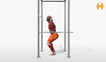
The wide stance barbell parallel (full) squat develops power and strength in the legs and glutes. The full range of motion emphasizes the glutes. The wide stance targets the inner thigh muscles. Warm-up thoroughly before performing full squats.
Wide-Stance Dumbbell Squat
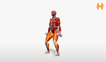
The wide stance dumbbell squat strengthens and defines the legs and inner thighs. The dumbbells reduce loading on the spine and therefore make a good alternative to back squats. Dumbbell squats can be performed at home or in the gym. Include this exercise on your lower-body workout day.
Zigzag Run
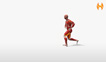
The zigzag run is an agility drill. This exercise can be used as a dynamic warm-up or for conditioning purposes. The zigzag run develops hip flexibility, body balance, and increase body awareness. Keep the rest periods brief to burn maximum calories per session.
Seated Abdominal Bracing
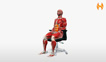
The seated abdominal bracing exercise can be done anywhere you can sit down. It is a very simple isometric exercise to strengthen your abs. When performing the seated abdominal bracing be sure that you are sitting up straight. This is a good exercise for beginners and people who don't have a lot of time to exercise, the seated abdominal bracing can be done on the ride home from the gym.
Seated Back Stretch
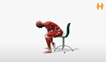
The seated back stretch is essential for every office worker. All you need is a chair so there is no reason not to perform it. The seated back stretch will help relieve tension in your low back and help you feel better. While this is a gentle stretch it is still best to warm up before stretching.
Side Bend
The side bend stretches the spinal lateral flexors, obliques and ipsilateral trunk extensors. The side bend can be performed at work or at the end of a workout. Stretch both sides of the body for maximum benefit. Reach the arm overhead to increase the effectiveness of the side bend.
Side Rock
The side rock performed while seated stretches the torso. The side rock requires core, trunk, and hip activation. Positioning the hands above the head stretch the lats.
Standing Long Jump
The standing long jump develops powerful legs and glutes. This exercise can be used to condition the entire body. Combine the standing long jump with back squats to develop explosive strength in the lower body. When repeated for many reps, the standing long jump develops full-body fitness.
Straight-leg Sit Up
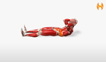
The straight leg sit up is a challenging exercise that develops strength in the abdominals and hip flexors. Straight leg sit ups should not be performed by anyone with low back problems. This is a very challenging exercise that is much harder than bent knee sit ups.
Straight-leg Sling Sit-ups
Straight-leg sling sit-ups develop power in the core and upper-body. Straight-leg sling sit-ups require more hip flexor strength than the Bent-knee sling sit-ups. Perform this exercise only if you have no back injuries or pain. This is a good exercise for anyone looking to take their ab training to the next level.
Trampoline Clock Drill
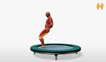
The trampoline clock drill increases coordination, balance, and body awareness. The trampoline requires additional ankle, knee, and hip stabilization. This exercise can also be used for conditioning the cardiovascular system. If a trampoline is unavailable perform this exercise on the floor.
Tuck Jump
The tuck jump is a plyometric exercise that increases power in the hips, legs, and trunk. The ballistic nature of this exercise requires a strong base level of strength in the legs. It's recommended that beginners do not perform this exercise.
Twisting Side Bend
The twisting side bend stretches the inner thighs, torso, and lat muscles. This is a good stretch to perform following a lower body workout or between sets. Increase the stretch by reaching your arm overhead.
Vertical Jump – Counter Movement
The vertical jump with counter movement increases power and explosiveness in the hips, legs, shoulders, and arms. With repeated jumps the body's cardio-respiratory system is challenged making this an excellent conditioning exercise.
Walking Lunge Rotation
Walking lunges with rotation strengthens the legs, hips and torso. The rotation activates the obliques and challenges your balance. A medicine ball may be used to add resistance to the body and further activate the core muscles.